If your cold brew keeps coming out too strong, too weak, or different every time, the problem is almost never your coffee beans. It is your ratio.
A cold brew ratio is simply how much coffee you use compared with how much water. Change that one number and you change strength, sweetness, body, and how long the batch lasts. This guide gives you the ratios that work, explains concentrate versus ready-to-drink in plain terms, and shows you how to scale a batch up or down without doing maths every time.
If you have not made a batch yet, start with our full method first: How to Make Cold Brew Coffee. The guide below is the ratio companion to that recipe.
The short answer
- For concentrate, use 1:4. That is 1 part coffee to 4 parts water. For example, 100 grams of coarsely ground coffee to 400 millilitres of water. Dilute it before drinking.
- For ready-to-drink cold brew, use 1:8. That is 1 part coffee to 8 parts water. For example, 100 grams of coffee to 800 millilitres of water. Pour it straight over ice.
- For extra-strong concentrate, use 1:3. That is 100 grams of coffee to 300 millilitres of water. Dilute it more, and expect a heavier, syrupy cup.
If you only remember one ratio, remember 1:4. It is the most forgiving starting point, it stores well, and you can always dilute it to the strength you like.
How to read a cold brew ratio
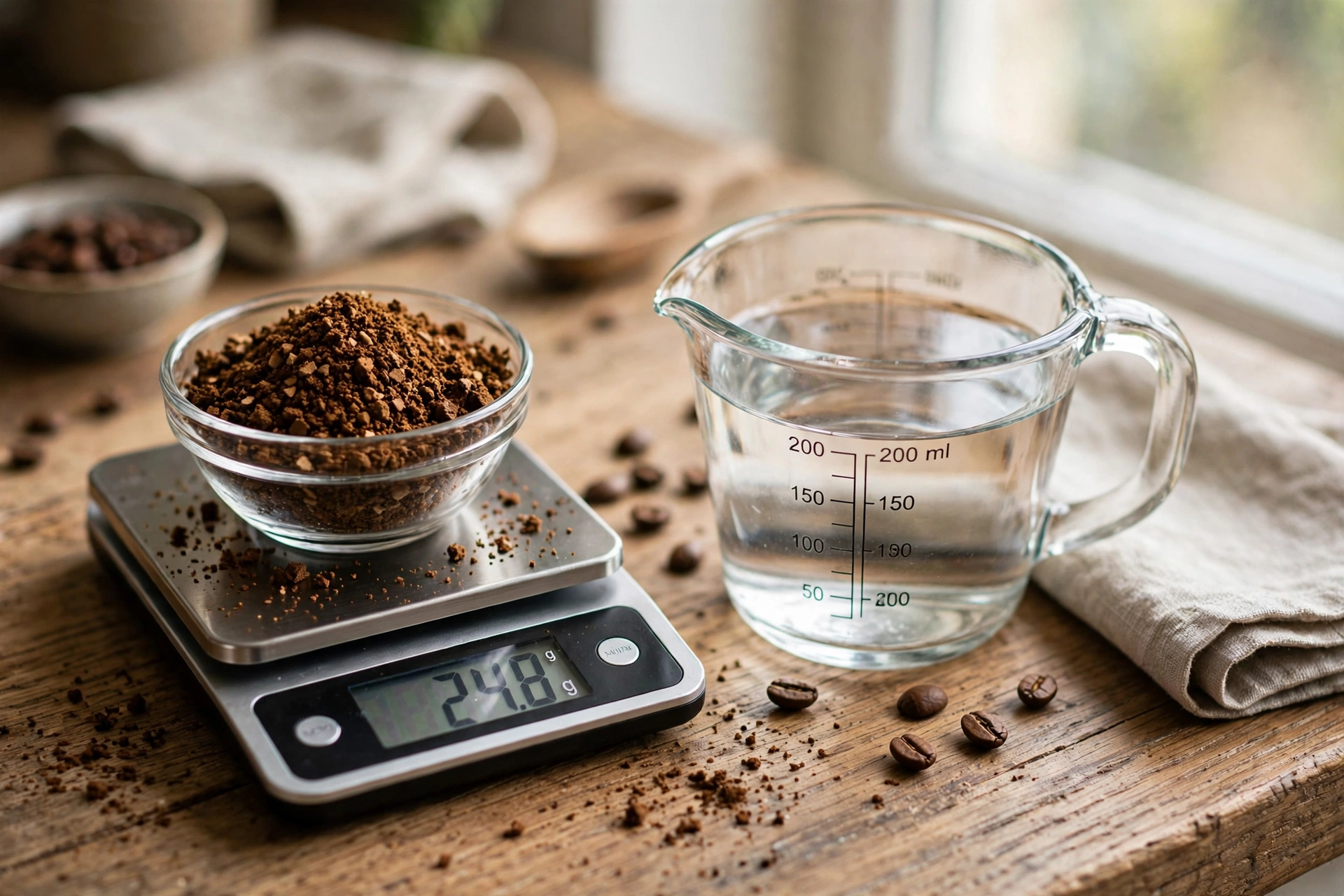
A ratio such as 1:4 is read as coffee first, water second. The numbers can be grams, millilitres, cups, or any unit, as long as you use the same idea for both sides. In practice, weight is far more reliable than cups.
One cup of coarsely ground coffee usually weighs about 80 to 100 grams, but that changes with the bean, the roast, and how coarsely you grind. Two scoops from two different bags are rarely the same weight. That is why a batch made by cups can taste different even when you follow the same recipe.
Water is easier: 1 millilitre of water weighs 1 gram, so grams and millilitres match. If you have a kitchen scale, use it for the coffee and measure the water in millilitres. You do not need special equipment, and your next batch will taste like the last one that worked.
If you do not have a scale, cups still work. Just know they are approximate. Use the same scoop, the same grind, and the same jar every time, and write down what worked.
Concentrate vs ready-to-drink: what is actually different?
Concentrate and ready-to-drink cold brew are not two different drinks. They are the same steeping process with different amounts of water.
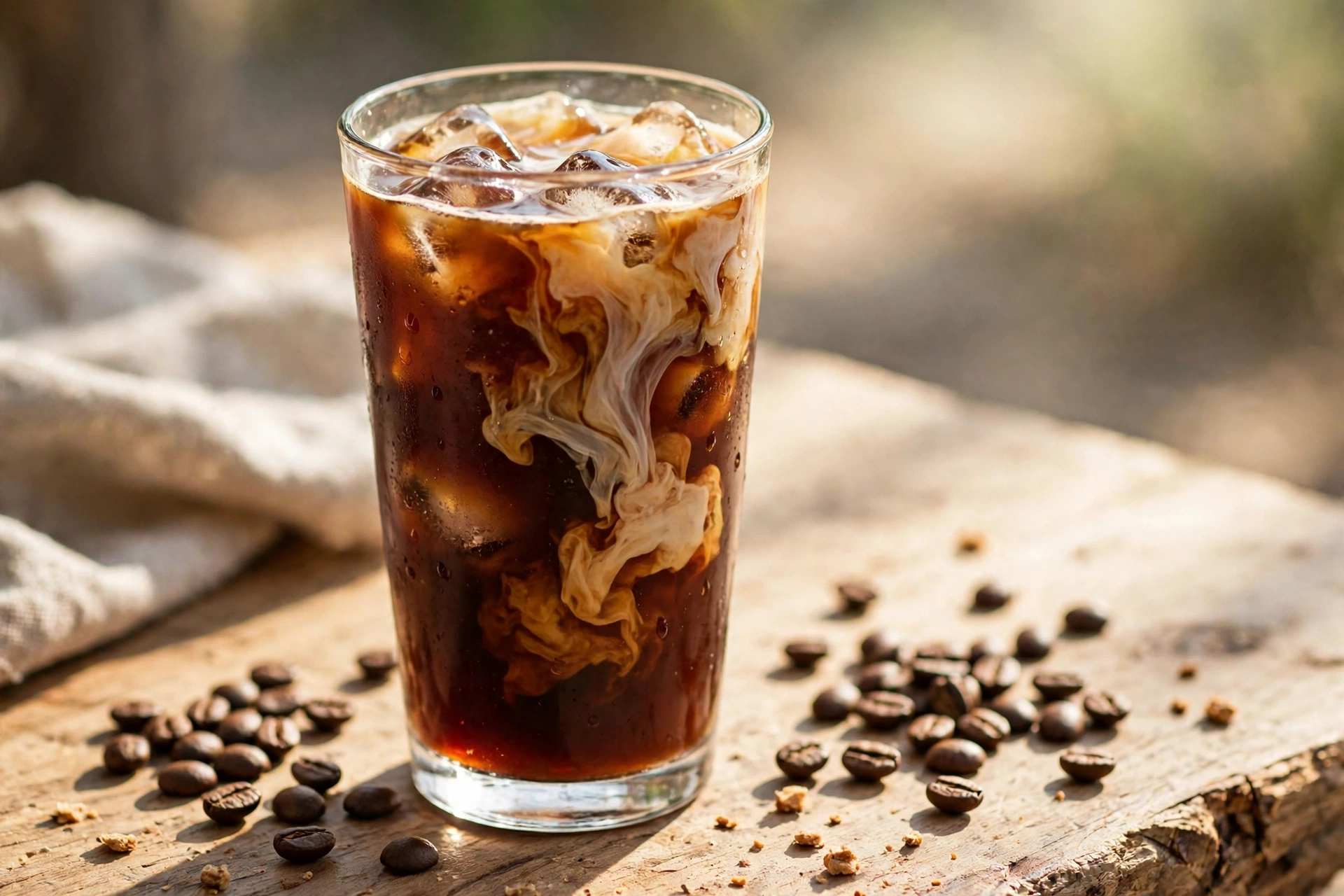
Concentrate uses less water, so the coffee that comes out of the jar is strong, dark, and intense. You are meant to dilute it. That makes it flexible: one batch can become black cold brew, a milky latte, or a sweet cream drink, just by changing what you add to the glass.
Ready-to-drink cold brew uses more water from the start, so it comes out at drinking strength. You pour it over ice and drink it. It is simpler, but less flexible. You cannot make it stronger later, and a batch takes up more fridge space for the same amount of coffee.
Here is the practical comparison:
| Type | Ratio | Best for | Dilution |
|---|---|---|---|
| Extra-strong concentrate | 1:3 | Small fridge space, milky drinks | Dilute 1:2 or more |
| Concentrate | 1:4 | Most home brewers, flexible serving | Dilute 1:1 or 1:2 |
| Ready-to-drink | 1:8 | Pour-and-go iced coffee | None, pour over ice |
Choose concentrate if you like variety, if fridge space is tight, or if you often add milk. Choose ready-to-drink if you want the simplest possible routine and you mostly drink your cold brew black over ice.
Scaling table: how much coffee and water do you need?
Use this table to scale without recalculating. All amounts use coarsely ground coffee and cold filtered water.
Concentrate at 1:4:
| Coffee | Water | What you get |
|---|---|---|
| 50 g | 200 ml | About 1 to 2 servings of concentrate |
| 100 g | 400 ml | About 4 cups of concentrate |
| 150 g | 600 ml | A medium jar batch |
| 200 g | 800 ml | A large jar batch |
Ready-to-drink at 1:8:
| Coffee | Water | What you get |
|---|---|---|
| 50 g | 400 ml | About 2 glasses |
| 100 g | 800 ml | About 4 glasses |
| 150 g | 1,200 ml | A large batch for the week |
| 200 g | 1,600 ml | A very large batch, check jar size first |
Remember that the grounds soak up some water, so the amount you strain out will be a little less than the water you put in. That is normal. Do not top it up with extra water after straining unless you are diluting a concentrate on purpose.
How to dilute concentrate
Dilution is where most people go wrong, because they treat concentrate like ready-to-drink coffee and drink it straight. It will taste harsh that way, and that harshness is not a sign that your beans or steep time were wrong.
Start here:
- For black cold brew: mix 1 part concentrate with 1 part cold water, then pour over ice. Taste it. If it is still too strong, move to 1 part concentrate to 2 parts water.
- For a milky drink: mix 1 part concentrate with 1 part milk, or half water and half milk. Milk softens the coffee, so you may want a slightly stronger mix than you use for black cold brew.
- For sweet cream or flavoured drinks: start at 1:1, then add your sweetener or cream and taste again. Sweetness changes how strong the coffee feels, so adjust after sweetening, not before.
Write down the dilution that tasted right to you. “1:4 concentrate, diluted 1:1” is a complete recipe you can repeat, and it is far more useful than “strong” or “weak” as a note.

What if you only have cups, not a scale?
You can still make good cold brew. Use these cup versions of the same ratios, and keep them consistent:
- Concentrate: 1 cup of coarsely ground coffee to 4 cups of cold water.
- Ready-to-drink: 1 cup of coarsely ground coffee to 8 cups of cold water.
- Extra-strong concentrate: 1 cup of coarsely ground coffee to 3 cups of cold water.
The catch is that a cup of grounds is not a fixed weight. If you change beans or grind size, your cup will weigh something different, and the coffee will taste different. That does not mean cups are bad. It means you should treat your first cup-based batch as a test, taste it, and adjust the next batch by a small amount rather than changing everything at once.
A cheap kitchen scale removes that guesswork, and it is the single upgrade that improves cold brew consistency the most.
Does grind size or steep time change the ratio?
Ratio, grind, and steep time work together, but they are not the same thing. Ratio sets the strength ceiling. Grind and steep time decide how much flavour you extract within that ratio.
Coarse grind is the standard for cold brew because it steeps slowly and strains cleanly. A fine grind extracts faster and can turn bitter over a long steep, even at the right ratio. If your coffee tastes bitter, do not immediately change the ratio. Check the grind first, then the steep time.
Steep time works the same way. Most batches do well at 12 to 24 hours, with 16 hours a good starting point. A short steep can taste thin even at a strong ratio, and a very long steep can taste heavy or bitter even at a weaker ratio. Change one variable at a time: ratio first, then steep time, then grind. Changing all three at once makes it impossible to know what fixed the problem.
Common ratio mistakes
Drinking concentrate straight. This is the most common mistake, and it makes good cold brew taste harsh. Dilute first, taste, then adjust.
Using the same ratio for every bean. A dark roast often tastes stronger and heavier than a light roast at the same ratio. If you switch roasts, start with your usual ratio, taste, and nudge the dilution rather than rebuilding the recipe.
Scaling by eye. Doubling a batch by eye usually means doubling the coffee but not quite doubling the water, or the other way round. Use the scaling table above, even for a rough batch.
Forgetting that ice dilutes too. Ice melts. A glass packed with ice will taste weaker after a few minutes than it did on the first sip. If you like your cold brew strong, start slightly stronger than your ideal, or use cold brew ice cubes made from a previous batch.
Squeezing the grounds dry. Squeezing pushes fine sediment and bitter compounds into the coffee. Let it drain, strain twice, and accept the small loss. Your ratio was calculated for the coffee that strains out cleanly, not for every last drop.
Troubleshooting by ratio
- Too strong or harsh: you may be drinking concentrate undiluted, using a 1:3 ratio when you wanted 1:4, or steeping too long. Dilute more first, then check steep time.
- Too weak or watery: you may have used a ready-to-drink ratio but then diluted it again, used too little coffee for your jar, or steeped too short. Check whether you diluted twice by accident.
- Different every time: you are probably measuring by cups with different beans or grinds. Switch to weight for one batch and compare.
- Cloudy or gritty: this is usually a straining problem, not a ratio problem. Strain through a mesh first, then through a paper coffee filter or cheesecloth, without squeezing.
Which ratio should you start with?
If you are new to cold brew, start with 1:4 concentrate, steeped for 16 hours, diluted 1:1 with cold water over ice. It is the middle of the road in every sense: strong enough to taste like coffee, flexible enough to adjust, and easy to store.
After that first batch, adjust in one direction only:
- Too strong? Dilute more, or try 1:5 next time.
- Too weak? Dilute less, or try 1:3 next time.
- Just right? Write it down exactly, including the bean, the grind, the steep time, and the dilution. That note is your personal ratio, and it is worth more than any general table.
Cold brew rewards consistency more than perfection. Once you find a ratio that tastes right in your jar, with your beans, in your fridge, you can repeat it for months.
Frequently asked questions
What is the best cold brew ratio for beginners?
1:4 concentrate, diluted 1:1 with water. It is forgiving, stores well, and lets you adjust strength in the glass without making a new batch.
Is 1:4 by weight or by volume?
By weight is best: 100 grams of coffee to 400 millilitres of water. By volume, 1 cup of grounds to 4 cups of water is close, but less precise because a cup of grounds does not always weigh the same.
Can I use the same ratio for a French press and a jar?
Yes, the ratio does not change with the container. What changes is straining and capacity. A French press is convenient for pressing, but still strain the coffee well if you want a clean cup.
How much cold brew concentrate should I drink at once?
Treat concentrate as an ingredient, not a finished drink. A typical serving uses about half a cup of concentrate diluted to a full glass. Caffeine varies by bean and dilution, so start with a smaller serving if you are sensitive to caffeine.
Does a stronger ratio mean more caffeine?
Generally, yes, per glass, because there is more coffee behind each serving. But dilution matters just as much. A 1:3 concentrate diluted 1:2 can end up similar in strength to a 1:4 concentrate diluted 1:1. Judge by the finished glass, not by the jar alone.